

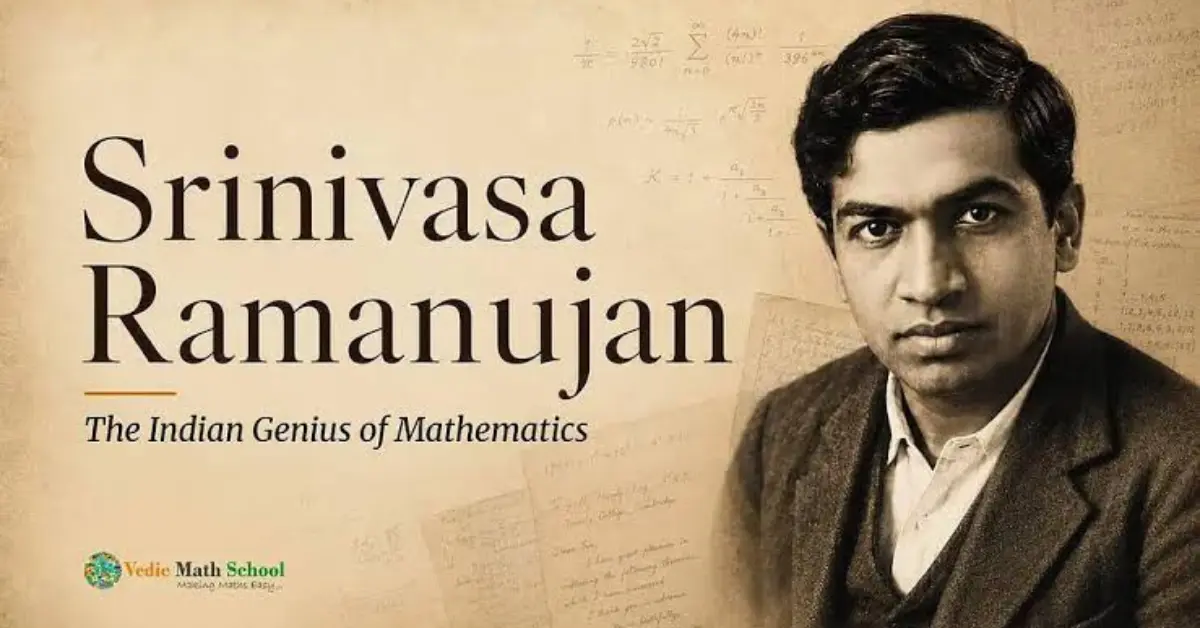
Srinivasa Ramanujan was one of the greatest mathematicians in Indian history. He is famous for his extraordinary contributions to number theory, infinite series, mathematical analysis, and continued fractions. His mathematical abilities became visible at a very young age, even though he faced several difficulties in his formal education.
The story of Srinivasa Ramanujan education is an inspiration for students because he developed advanced mathematical knowledge through independent study, curiosity, and dedication. Despite financial problems and academic challenges, he became internationally recognized for his remarkable mathematical discoveries.
Early Life of Srinivasa Ramanujan
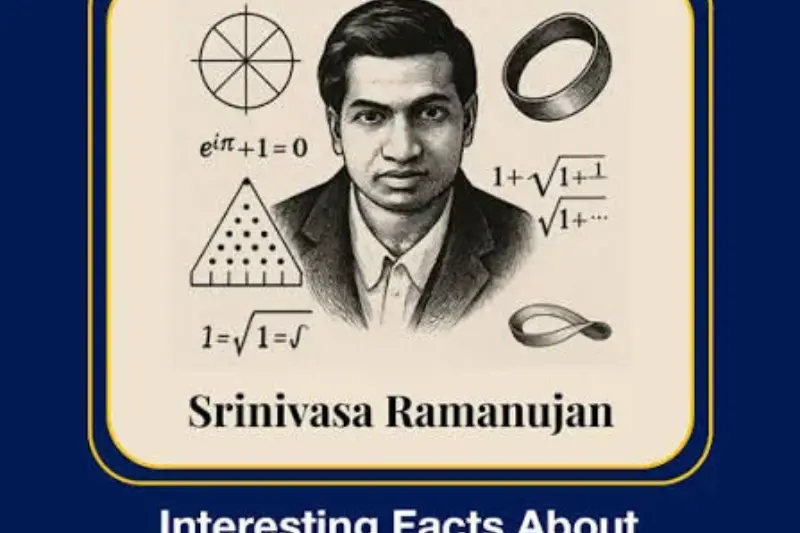
Srinivasa Ramanujan was born on 22 December 1887 in Erode, Tamil Nadu, India. His full name was Srinivasa Ramanujan Aiyangar. He grew up in Kumbakonam, where he spent most of his childhood.
His family had limited financial resources, but his parents supported his education. From an early age, Ramanujan showed a special interest in numbers and mathematical problems.
He was naturally curious and enjoyed solving difficult questions. His extraordinary memory and ability to understand mathematical concepts helped him develop strong academic skills.
Primary School Education
Ramanujan started his primary education at a young age. He attended different local schools before joining Town High School in Kumbakonam.
During his early school years, he demonstrated excellent abilities in mathematics. He quickly understood mathematical concepts and often solved problems beyond his grade level.
His teachers recognized his intelligence and encouraged him to continue studying.
His primary education helped him develop the basic knowledge that later became the foundation of his mathematical research.
School Education at Town High School
In January 1898, Srinivasa Ramanujan joined Town High School in Kumbakonam.
He performed exceptionally well in mathematics and showed considerable interest in other academic subjects. However, mathematics remained his favorite subject.
At school, he studied:
- Mathematics
- English
- Tamil
- Science
- Geography
- History
By the age of 12, he had developed a strong understanding of trigonometry. He also began exploring advanced mathematical ideas independently.
His ability to solve complicated mathematical problems made him different from other students.
The Book That Changed His Mathematical Journey
One of the most important moments in Srinivasa Ramanujan’s education was discovering a mathematics book written by George Shoobridge Carr.
The book was titled A Synopsis of Elementary Results in Pure and Applied Mathematics.
Ramanujan obtained access to this book when he was approximately 16 years old. It contained thousands of mathematical formulas, theorems, and results.
He carefully studied the material and attempted to understand and prove many mathematical results independently.
The book introduced him to several advanced mathematical concepts, including:
- Algebra
- Calculus
- Trigonometry
- Infinite series
- Number theory
- Continued fractions
This book played a significant role in developing his mathematical knowledge and encouraging him to explore new ideas.
College Education of Srinivasa Ramanujan
After completing his school education, Ramanujan received a scholarship to study at Government College in Kumbakonam in 1904.
The college provided him with an opportunity to continue his higher education. However, his strong concentration on mathematics affected his performance in other subjects.
He spent most of his time studying mathematical problems and neglected subjects such as English and other compulsory courses.
As a result, he failed to meet the academic requirements and lost his scholarship.
This experience became a major setback in his formal education.
Education at Pachaiyappa’s College
After leaving Government College, Ramanujan continued his educational journey at Pachaiyappa’s College in Madras, now known as Chennai.
He joined the college in 1906 to prepare for the First Arts examination.
Although he performed well in mathematics, his health problems and lack of interest in other subjects affected his academic performance.
He could not successfully complete the examination and therefore did not receive a conventional college degree during this period.
Despite these difficulties, he continued working on mathematical problems and developing his independent research.
Did Srinivasa Ramanujan Complete His University Education?
Srinivasa Ramanujan did not complete a conventional university degree through the regular education system in India.
However, his lack of formal qualifications did not prevent him from becoming one of the world’s most respected mathematicians.
In 1913, he began corresponding with the famous British mathematician G. H. Hardy. Hardy recognized the originality of his mathematical work and invited him to Cambridge University.
In 1914, Ramanujan travelled to England to work with Hardy.
In 1916, he received a Bachelor of Arts by Research degree from Cambridge University for his mathematical contributions.
This achievement marked an important stage in his academic and professional journey.
Role of G. H. Hardy in Ramanujan’s Education
G. H. Hardy played an important role in the academic development of Srinivasa Ramanujan.
Before meeting Hardy, Ramanujan had developed many mathematical ideas through independent study. However, he had limited knowledge of some modern mathematical methods and formal proof techniques.
Hardy helped him understand advanced mathematical concepts and encouraged him to present his discoveries in a more systematic way.
Their collaboration produced important mathematical research and helped Ramanujan gain international recognition.
Their partnership became one of the most famous collaborations in the history of mathematics.
You may also like these posts:
Anytime Fitness: A Complete Guide to Membership and Benefits
Bajaj Housing Finance Share Price and Stock Analysis
Tech Mahindra Share Price and Stock Analysis Guide
Education Portal 3.0: Login, Registration and Features
Major Mathematical Subjects Studied by Ramanujan
Srinivasa Ramanujan explored several advanced areas of mathematics throughout his life.
Number Theory
Number theory was one of Ramanujan’s most important research areas. He made remarkable discoveries involving integers, prime numbers, and mathematical patterns.
Infinite Series
He developed important formulas and identities involving infinite series, which became valuable contributions to mathematical research.
Continued Fractions
Ramanujan made significant discoveries involving continued fractions and their mathematical properties.
Mathematical Analysis
He explored advanced mathematical relationships involving functions, limits, and infinite processes.
Partition Theory
His work on partition numbers became an important contribution to number theory and mathematical analysis.
Major Achievements of Srinivasa Ramanujan
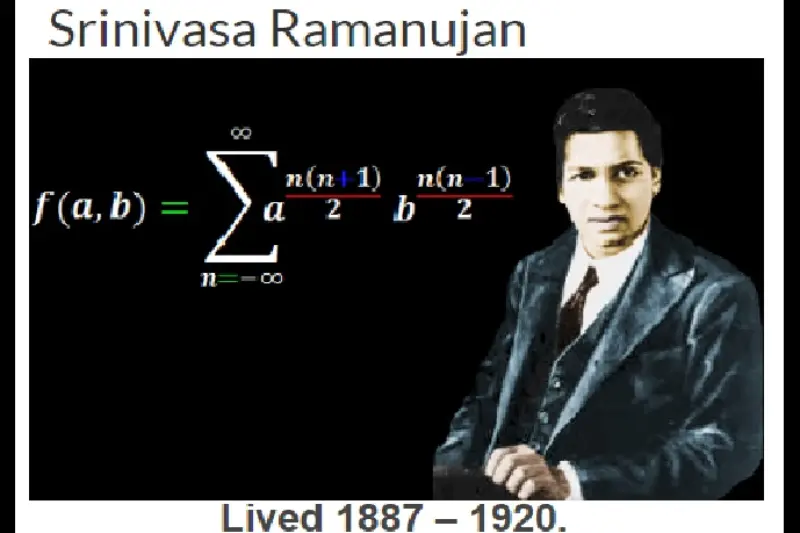
Despite facing difficulties in formal education, Ramanujan achieved international recognition for his mathematical discoveries.
Some of his major achievements include:
- Published his first research paper on Bernoulli numbers in 1911.
- Worked with G. H. Hardy at Cambridge University.
- Received a Bachelor of Arts by Research degree in 1916.
- Became a Fellow of the Royal Society in 1918.
- Became the first Indian to be elected a Fellow of Trinity College, Cambridge, in 1918.
- Made important contributions to number theory, infinite series, and continued fractions.
His achievements demonstrate the importance of curiosity, independent learning, and dedication.
Lessons Students Can Learn from Srinivasa Ramanujan’s Education
The educational journey of Srinivasa Ramanujan provides several valuable lessons for students.
1. Follow Your Interests: Students should explore subjects they genuinely enjoy and develop their knowledge through continuous learning.
2. Develop Problem-Solving Skills: Practising mathematical problems can improve logical thinking and analytical abilities.
3. Never Stop Learning: Education is not limited to classrooms, colleges, or universities. Independent learning can also lead to important discoveries.
4. Stay Dedicated: Consistency and hard work are essential for achieving academic and professional goals.
5. Learn from Difficulties: Academic challenges should encourage students to improve their skills and find better ways to learn.
Frequently Asked Questions
1. Where did Srinivasa Ramanujan complete his school education?
Srinivasa Ramanujan attended Town High School in Kumbakonam, Tamil Nadu, where he demonstrated exceptional mathematical abilities.
2. Which college did Srinivasa Ramanujan attend?
He attended Government College in Kumbakonam and later studied at Pachaiyappa’s College in Madras.
3. Did Srinivasa Ramanujan complete his college degree?
He did not complete a conventional college degree in India. However, he received a Bachelor of Arts by Research degree from Cambridge University in 1916.
4. Which mathematics book influenced Srinivasa Ramanujan?
A Synopsis of Elementary Results in Pure and Applied Mathematics by George Shoobridge Carr significantly influenced his mathematical development.
5. Who helped Srinivasa Ramanujan develop his mathematical knowledge at Cambridge?
G. H. Hardy helped Ramanujan develop his mathematical research and introduced him to advanced mathematical methods.
Conclusion
Srinivasa Ramanujan’s education was different from the traditional academic journey of most mathematicians. He attended Town High School in Kumbakonam, studied at Government College, and later joined Pachaiyappa’s College in Madras. However, he could not complete his early college studies because of his intense focus on mathematics and difficulties in other subjects.
His independent learning, extraordinary mathematical abilities, and collaboration with G. H. Hardy eventually helped him earn a research degree from Cambridge University. His life demonstrates that dedication, curiosity, and continuous learning can create extraordinary opportunities.
