


Introduction
Mitosis aik aisi cellular process hai jo eukaryotic cells me nucleus ke division ko explain karti hai. Ye process organism ke growth, repair aur asexual reproduction ke liye zaroori hai. Onion root tip ko commonly mitosis ke study ke liye use kiya jata hai kyun ke yahan cells actively divide kar rahe hote hain, jo microscope se clearly observe kiye ja sakte hain.
Video workflow note: for color grading and video editing, this DaVinci Resolve tutorials is a useful related reference.
Mitosis ka study students aur researchers ke liye fundamental hai kyun ke ye cellular organization aur genetics ke understanding me basic role play karta hai.
Objective
- Onion root tip me mitosis ki alag-alag stages ko observe karna.
- Cell division ke process ko understand karna.
- Chromosome behavior aur distribution ka analysis karna.
Theory
Mitosis aik highly organized process hai jo nucleus ko 4 main stages me divide karta hai:
Prophase: Chromosomes condense hote hain aur spindle fibers form hote hain. Nucleus ki membrane dissolve ho jati hai.
Metaphase: Chromosomes cell ke equator me align hote hain. Spindle fibers chromosomes ke centromere se attach hote hain.
Anaphase: Chromatids separate hoke opposite poles ki taraf move karte hain.
Telophase: Nucleus ki membrane dobara form hoti hai, aur chromosomes decondense hote hain.
Iske baad Cytokinesis hoti hai jahan cytoplasm divide hota hai aur 2 genetically identical daughter cells bante hain.
Why Onion Root Tip?
Rapidly dividing cells.
Thin and transparent root tip easily stain kiya ja sakta hai.
Chromosomes easily visible hote hain under microscope.
You May Also Like It
Toppers Study Tips: Complete Guide to Study Smart and Score High
Study Tips for Class 10: A Complete Guide for Students to Score Better
Vastu Tips for Study Room Complete Guide for Better Focus, Success & Positive Energy
Materials Required
- Onion bulb
- Microscope slides and cover slips
- Microscope
- Scalpel or razor blade
- Acetic acid
- Alcohol (70%)
- Acetocarmine or Feulgen stain
- Forceps and dropper
- Water
why is important study of mitosis in onion root tip
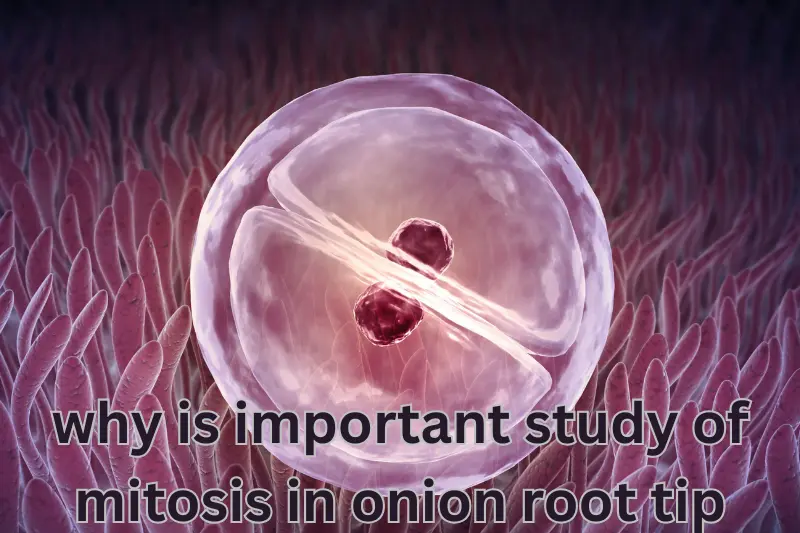
Understanding Cell Division
Mitosis is the process by which a cell divides to produce two identical daughter cells.
Observing onion root tip cells helps students clearly see how chromosomes behave during this process.
Educational Significance
It’s a classic experiment in biology labs, helping students learn about the stages of mitosis: Prophase, Metaphase, Anaphase, and Telophase.
It provides hands-on experience in microscopy and slide preparation.
Why Onion Root Tip is Used
Root tip cells divide rapidly, so many cells are in mitosis at any given time.
Cells are thin and easy to stain, making chromosomes visible under a microscope.
fGenetic and Biological Insights
Helps understand how genetic material (chromosomes) is equally distributed to daughter cells.
Provides insight into growth, repair, and reproduction in plants.
Practical Applications
Research & Medicine: Understanding mitosis is essential in cancer research, since uncontrolled mitosis leads to tumor formation.
Plant Breeding: Knowledge of cell division helps in plant genetics and breeding experiments.
You May Also Like It
Learn Reiki Online at Home – Step-by-Step Reiki Healing Course for Beginners
Study of Mitosis in Onion Root Tip – Complete Guide for Students
3 Secret Study Tips to Become Topper | Boost Your Exam Scores Fast
Method / Procedure
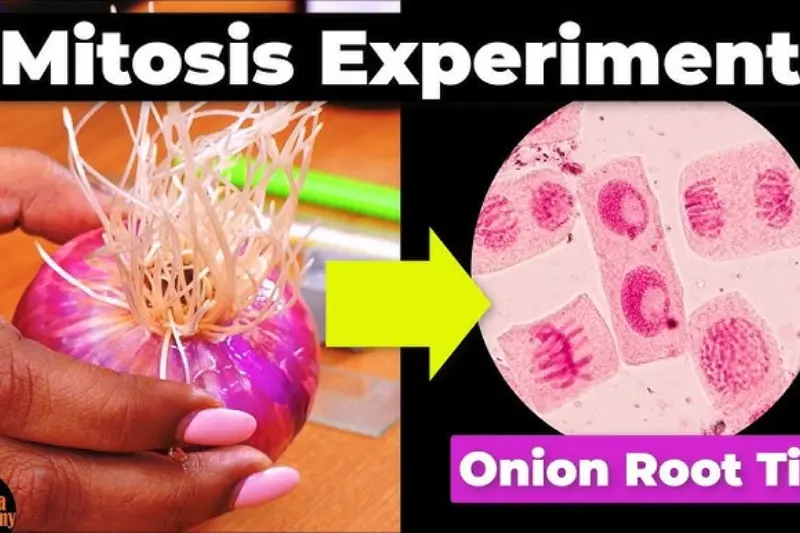
Step 1: Preparation of Root Tip
Onion bulb se fresh roots cut karein (1–2 cm long).
Root tips ko 0.5% acetic acid me 5–10 minutes ke liye treat karein (fixation) takay cell structure preserve ho jaye.
Step 2: Hydrolysis
Root tips ko 1N HCl me 5 minutes ke liye warm karein (60°C) takay cell wall soft ho jaye.
Alcohol me rinse karein takay excess HCl remove ho jaye.
Step 3: Staining
Root tip ko acetocarmine ya Feulgen stain me 15–20 minutes ke liye stain karein.
Chromosomes bright red ya purple color me appear honge.
Step 4: Squash Technique
Slide par root tip place karein.
Cover slip rakhein aur gently press karein takay cells flatten ho jayein (squash).
Step 5: Observation
Microscope me slide observe karein (40x or 100x).
Mitosis ke stages identify karein: Prophase, Metaphase, Anaphase, Telophase.
Diagram draw karein ya photographs lein.
Results
Onion root tip cells me clearly mitotic stages observe kiye gaye.
Most cells prophase me the, jo indicate karta hai ke prophase duration zyada hoti hai.
Chromosomes ki equal distribution daughter cells me observe hui.
Significance of Study
Growth Analysis: Mitosis explain karta hai organism ke growth process ko.
Genetic Consistency: Daughter cells genetically identical hote hain.
Cancer Research: Uncontrolled mitosis cancer me hoti hai.
Plant Breeding: Root tip study plant genetics aur breeding me helpful hai.
Common faqs
What is mitosis?
Mitosis is the process of cell division in eukaryotic cells where one parent cell divides to form two genetically identical daughter cells.
Why is the onion root tip used to study mitosis?
Because its cells divide rapidly, are transparent, and chromosomes can be easily observed under a microscope.
What are the main stages of mitosis?
The four main stages are Prophase, Metaphase, Anaphase, and Telophase, followed by Cytokinesis.
What is the purpose of staining the onion root tip?
Staining highlights chromosomes, making them visible under a microscope for observation of mitotic stages.
What is the significance of studying mitosis?
It helps understand cell growth, repair, genetic consistency, and is essential in biology education and research.
Which stain is commonly used for onion root tips?
Acetocarmine or Feulgen stain is commonly used to visualize chromosomes.
What is the longest stage of mitosis and why?
Prophase is usually the longest stage because chromosomes condense and spindle fibers form.
What is cytokinesis?
Cytokinesis is the division of the cytoplasm, resulting in two separate daughter cells
How can one identify metaphase in the onion root tip?
In metaphase, chromosomes align along the equatorial plane (middle) of the cell.
How does studying onion root tip mitosis help in real life?
It provides insight into growth, cancer research, plant breeding, and understanding of genetic inheritance.
Conclusion
The study of mitosis in the onion root tip provides a clear and practical understanding of how eukaryotic cells divide. By observing the actively dividing cells at the root tip, students can identify all the stages of mitosis—Prophase, Metaphase, Anaphase, and Telophase—and understand the process of cytokinesis, where the cytoplasm divides to form two daughter cells.
This experiment demonstrates the accurate distribution of genetic material and the importance of mitosis in growth, repair, and reproduction. The onion root tip serves as an ideal specimen because of its rapid cell division and ease of staining, making chromosome observation simple and effective.
Overall, studying mitosis in onion root tips bridges theoretical knowledge and practical observation, enhancing comprehension of fundamental biological processes and providing a foundation for advanced studies in genetics, cell biology, and plant sciences.
You May Also Like It
Online Hindi Learning Course – Learn Hindi Easily from Home
Learning Licence Apply Online Punjab – Complete Guide 2025
E-Gyan Mitra Online Learning: Your Modern Learning Companion
